

What are power forward and flyback?What is the difference between forward and flyback? How to distinguish quickly
May 10, 2021
Leave a message
Forward and flyback are two different switching power supply technologies
Forward switching power supply
01 Introduction
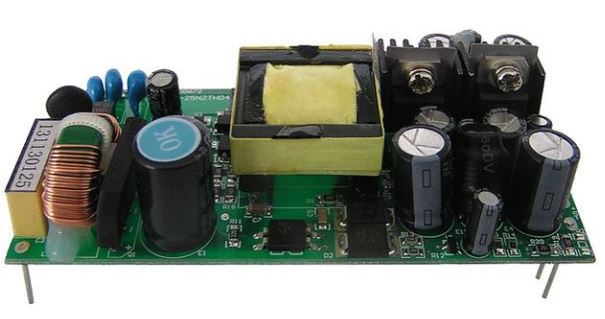
Forward switching power supply refers to a switching power supply that uses forward high frequency transformer isolation coupling energy. The forward switching power supply has a complicated structure and high output power. It is suitable for low voltage and high current (100W-300W) switching power supplies. widely.
The forward transformer only has a voltage transformation function, and the whole can be regarded as a buck circuit with a transformer.
02 Principle
Forward switching power supply: When the switch tube is turned on, the output transformer acts as a medium to directly couple the magnetic field energy, and the electric energy and the magnetic energy are converted into each other, so that the input and output are carried out at the same time.
As shown below

03 Disadvantages
To prevent the back electromotive force generated by the primary coil of the transformer from breaking down the switch tube, it is necessary to increase the back electromotive force winding
Add one more inductor to the secondary for energy storage filtering, which is costly
The volume of the forward switching power supply transformer is larger than that of the flyback switching power supply transformer.
Flyback switching power supply

01 Introduction
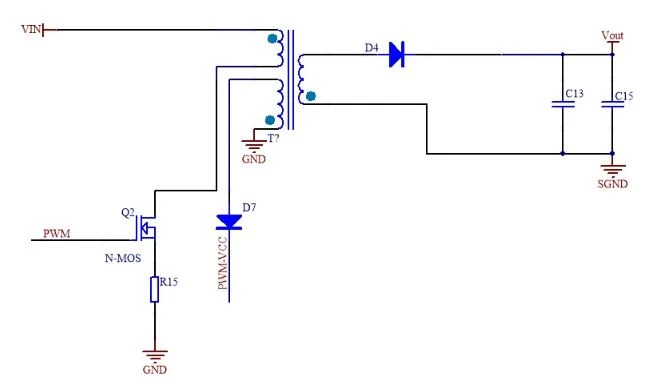
Flyback switching power supply refers to the use of a flyback high-frequency transformer to isolate the input and output circuits. The transformer not only transforms the voltage and transfers energy, but also functions as an energy storage inductor. The flyback transformer is similar to an inductor. the design of.
The circuit is relatively simple and easy to control, and the flyback type is widely used in the low power of 20-100W.
A flyback transformer can be regarded as an inductor with a voltage transformation function, which is a buck-boost circuit.
02 Principle
When the switch tube is turned on, the primary inductor current of the transformer rises. Because the output coil of the flyback circuit has the opposite end of the same name, the output diode is turned off, the transformer stores energy, and the load is supplied by the output capacitor;
When the switch tube is turned off, the inductor voltage on the primary side of the transformer is reversed. At this time, the output diode is turned on, and the energy of the transformer supplies power to the load through the diode and charges the capacitor at the same time.
03 Summary
The working principle is different: the forward excitation is the primary working and the secondary working, and the secondary is not working, there is freewheeling and the inductive freewheeling, usually in CCM mode. The power factor is generally not high, and the input and output are proportional to the duty cycle of the variable ratio. The flyback is the primary work, the secondary does not work, and the two sides are separated. Generally, in the DCM mode, the inductance of the transformer is relatively small, and an air gap is required, so it is generally suitable for small and medium power conditions.
The forward transformer is ideal and does not store energy, but because the magnetizing inductance is limited, the magnetizing current makes the magnetic core large. In order to avoid saturation of the magnetic flux, the transformer needs the auxiliary winding to reset the magnetic flux. The working form of the flyback transformer can be regarded as a coupled inductor; the inductor first stores energy and then discharges energy. Since the input and output voltages of the flyback transformer have opposite polarities, when the switch tube is disconnected, the secondary can provide a reset voltage to the magnetic core. Therefore, the flyback transformer does not need to add an additional magnetic flux reset winding.
For more information, please contact us at sales@xfullstar.com