

Planar Transformer vs Traditional Transformer: Which Is Better for High-Frequency Power Conversion?
Sep 17, 2026
Leave a message
For many high-frequency power conversion applications, planar transformers offer advantages in efficiency, thermal management, profile height, and manufacturing repeatability. However, traditional wound transformers remain competitive when flexibility, low initial cost, rapid prototyping, and low-volume production are the primary concerns. The optimal choice depends on switching frequency, power level, production volume, mechanical constraints, and insulation requirements.
The Frequency Challenge That Changed Transformer Design
For decades, the conventional wire-wound transformer was the standard solution for power conversion.
A typical design used copper wire wound around a ferrite core with a plastic bobbin-a simple, reliable, and well-established manufacturing approach.
However, as switching frequencies increased from tens of kilohertz into the hundreds of kilohertz and beyond, transformer design became increasingly challenging.
The adoption of wide-bandgap semiconductors such as GaN and SiC has accelerated this trend. Higher switching frequencies allow designers to reduce the size of magnetic components and increase power density, but they also introduce new challenges, especially in transformer winding losses.
One of the major issues is the increase in AC copper losses caused by skin effect and proximity effect.
At high frequencies, current distribution inside a conductor becomes non-uniform. Instead of using the entire cross-sectional area of the conductor, current tends to concentrate near the surface and interact with nearby conductors. This increases effective resistance and reduces transformer efficiency.
Planar transformers emerged as an alternative approach.
Instead of round wire windings, planar transformers use flat copper layers integrated into PCB structures. These copper layers are stacked and combined with planar ferrite cores, creating a compact magnetic component optimized for high-frequency operation.
However, planar transformers are not automatically superior in every application. Their advantages appear when the design requirements match their strengths.
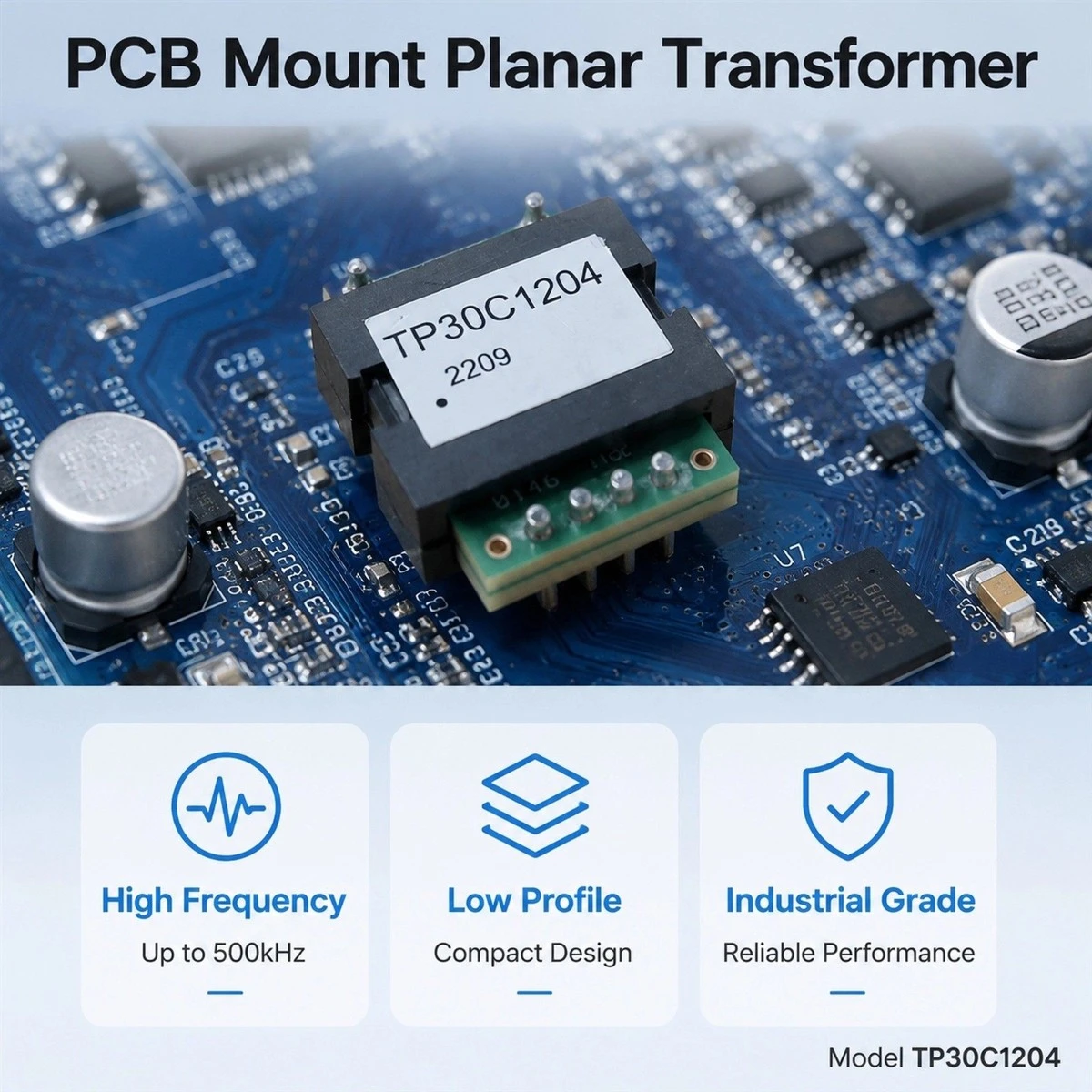
Planar Transformer vs Traditional Transformer: Key Differences
| Parameter | Planar Transformer | Traditional Wound Transformer |
|---|---|---|
| Profile Height | Very low profile; often below 20 mm depending on design | Higher vertical profile due to wire winding structure |
| High-Frequency Performance | Excellent when winding geometry is optimized | Increasing AC losses at higher frequencies |
| Power Density | High potential in compact, high-frequency designs | Limited by winding volume and thermal constraints |
| Leakage Inductance | Highly controllable through layer arrangement and interleaving | More dependent on winding technique |
| Thermal Management | Good PCB-level heat spreading capability | Depends on winding, bobbin, and core construction |
| Manufacturing Repeatability | Excellent due to PCB manufacturing processes | Depends more on winding consistency |
| Prototyping Speed | Requires PCB design and manufacturing preparation | Fast modification and sample production |
| Initial Cost | Higher engineering and tooling cost | Lower upfront cost |
| Low-Volume Production | Often less economical | Usually more cost-effective |
| Mechanical Flexibility | Limited after PCB design is finalized | Easier to modify |
Where Planar Transformers Have an Advantage
1. High-Frequency Efficiency and AC Loss Control
The main advantage of planar transformers is their ability to better manage high-frequency winding losses.
The flat copper structure provides more controlled conductor geometry compared with round wire. By adjusting:
- copper thickness
- layer arrangement
- interleaving structure
- winding distribution
engineers can reduce AC resistance caused by skin and proximity effects.
For high-frequency applications, especially above several hundred kilohertz, optimized planar structures can provide significant efficiency improvements compared with conventional winding methods.
However, planar transformers do not eliminate high-frequency losses completely. Poor winding layouts or unsuitable copper thickness can still create significant losses, so magnetic design optimization remains essential.
2. Low Profile and High Power Density
One of the most visible benefits of planar transformers is their compact vertical dimension.
Because the windings are integrated into PCB layers, planar transformers can achieve extremely low profiles compared with conventional magnetic components.
This makes them attractive for applications where height is limited, including:
- 1U power supplies
- server power modules
- slim adapters
- embedded power systems
- automotive power electronics
In high-volume designs, planar transformers can enable significantly higher power density by reducing magnetic component height and improving thermal integration.
3. Improved Thermal Integration
Thermal management is one of the biggest challenges in high-density power conversion.
Planar transformers offer several thermal advantages:
- large copper surface area
- short thermal paths
- direct connection to PCB copper structures
- easier integration with system-level cooling methods
Because the transformer winding is part of the PCB structure, heat can often be transferred more efficiently into the surrounding PCB and chassis compared with traditional wire windings.
This is particularly valuable in compact power converters where every watt of thermal loss matters.
4. Better Control of Parasitic Parameters
In many modern converter topologies, parasitic parameters are not simply unwanted effects-they are design variables.
For example, in:
- LLC resonant converters
- phase-shift full-bridge converters
- dual-active-bridge converters
leakage inductance can influence system performance.
Planar transformers allow designers to intentionally adjust leakage inductance through:
- winding separation
- layer positioning
- interleaving patterns
This level of control can reduce the need for additional magnetic components and simplify the overall power stage.
Where Traditional Transformers Still Have Advantages
1. Faster Prototyping and Greater Design Flexibility
The biggest advantage of traditional transformers is flexibility.
A conventional transformer can often be modified quickly by changing:
- turns ratio
- wire size
- winding arrangement
- insulation structure
For early-stage development, low-volume products, or applications where specifications may change frequently, this flexibility is extremely valuable.
A planar transformer typically requires:
- PCB redesign
- magnetic optimization
- core selection
- insulation verification
which increases development time.
2. Lower Initial Cost for Low-Volume Applications
Planar transformers usually require higher upfront engineering investment.
The development process may include:
- PCB layout
- magnetic simulation
- prototype fabrication
- validation testing
- safety review
For high-volume production, these costs can be amortized over thousands or millions of units.
For low-volume or customized products, however, traditional transformers often provide a more economical solution because they require less non-recurring engineering investment.
3. Better Fit When Board Area Is Limited
Planar transformers are thin, but they are not always smaller in total footprint.
Their larger planar structure may require more PCB area compared with a vertically oriented conventional transformer.
If the main mechanical limitation is:
- limited PCB space
- small board area
- compact horizontal footprint
a traditional transformer may be easier to integrate.
4. High-Current and Lower-Frequency Applications
Not every power converter benefits from planar construction.
For applications operating at lower switching frequencies or requiring very high current handling, traditional winding techniques can remain highly competitive.
Examples include:
- industrial power supplies
- motor drive systems
- high-current converters
In these cases, the additional complexity of planar construction may not provide enough benefit.
Planar Transformer vs Traditional Transformer: Selection Guide
| Application Requirement | Recommended Approach |
|---|---|
| Switching frequency above several hundred kHz | Planar transformer |
| Ultra-low profile requirement | Planar transformer |
| High production volume | Planar transformer |
| Need tight leakage inductance control | Planar transformer |
| Advanced resonant converter design | Planar transformer |
| Prototype development within days | Traditional transformer |
| Frequent design changes | Traditional transformer |
| Low-volume production | Traditional transformer |
| Minimum upfront engineering cost | Traditional transformer |
| Very limited PCB area | Traditional transformer |
Common Questions About Planar Transformers
Are planar transformers always more efficient?
No.
Planar transformers can provide better high-frequency performance when properly designed, but efficiency depends on the complete magnetic design, including core material, copper structure, operating frequency, and current density.
Are planar transformers more expensive?
Initially, yes.
They typically require higher engineering and manufacturing preparation costs. However, in medium- and high-volume production, automated PCB manufacturing can make them economically attractive.
What frequency is best for planar transformers?
There is no strict frequency boundary.
Planar transformers become increasingly attractive as switching frequencies move into the hundreds of kilohertz range and above, especially when low profile and high power density are important design goals.
Final Verdict: Choose Based on Constraints, Not Technology Trends
The question is not:
"Are planar transformers better than traditional transformers?"
The better question is:
"Which transformer technology best matches the requirements of this power converter?"
Planar transformers are powerful tools for modern high-frequency, high-density power conversion. They provide advantages in:
- compact form factor
- thermal integration
- repeatability
- parasitic control
They are especially suitable for applications such as:
- GaN-based chargers
- server power supplies
- automotive power electronics
- high-density DC-DC converters
Traditional wound transformers remain an important solution because they provide:
- faster development
- lower initial cost
- greater design flexibility
The most effective engineering approach is not replacing traditional transformers with planar designs universally, but selecting the appropriate magnetic technology based on frequency, volume, thermal requirements, mechanical constraints, and cost objectives.
For more information, please contact us at sales@xfullstar.com