

Introduction and Use of Ferrite Cores
Sep 11, 2018
Leave a message
The ferrite core is mainly composed of three metal elements of iron (Fe), manganese (Mn), and zinc (Zn), and is generally called manganese zinc ferrite. The toroidal ferrite core has a high magnetic effect because it has no air gap and a uniform cross-sectional area.
Ferrite magnetic rings are available in a wide range of sizes, depending on the material of the magnetic ring, and different coatings can be used to simplify winding and increase breakdown voltage.
The ferrite core is made of a dense homogeneous ceramic structure of a non-metallic magnetic material and has a low coercive force, also known as a soft ferrite. It consists of an oxide or carbonate compound of iron oxide (Fe2O3) and one or more other metals (eg manganese, zinc, nickel, magnesium). The ferrite material is pressed, then sintered at a high temperature of 1300 ° C, and finally processed into a finished magnetic core that meets the application requirements. Compared with other types of magnetic materials, the ferrite has the advantage of high magnetic permeability. And it has the advantages of high resistance and small eddy current loss in a wide frequency range. These material properties make ferrite an ideal material for applications such as high frequency transformers, broadband transformers, tunable inductors and other high frequency circuits from 10 kHz to 50 MHz.
Ferrite cores are available in a wide range of choices. Different materials and shapes can be selected according to different magnetic parameters. Due to low magnetic losses at high frequencies, they are widely used in switch mode power supplies (SMPS), radio frequency (RF) transformers. And inductors. Ferrite cores of various shapes and sizes are used in inductors, pulse transformers, high frequency transformers, and noise filters for high frequency power supplies and high quality communication markets. The most characteristic of ferrite is high permeability, good temperature characteristics, and low decay rate.
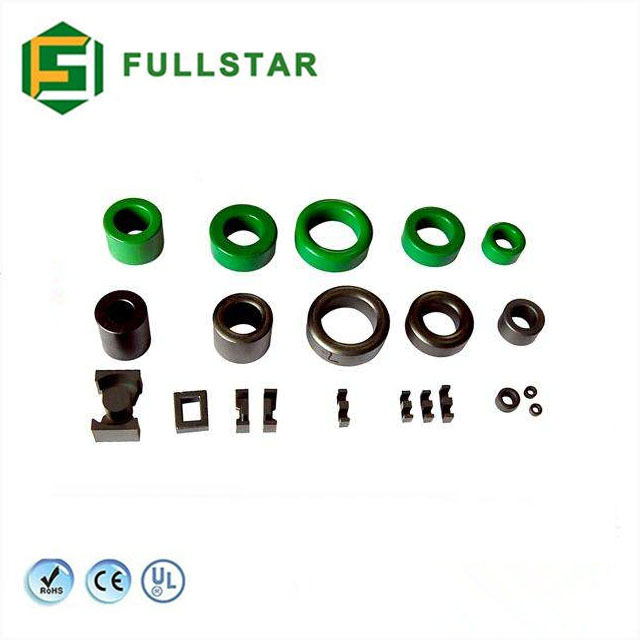
The difference between a nylon coating and an epoxy coating for a ferrite core: there is a similarity between the two. The nylon coating is thicker and can withstand temperatures up to 155oC. The epoxy coating is rated at 200oC. Nylon coatings are typically used in O.D. (outer diameter sizes) cores ranging from 12.7 mm to 29 mm. Extremely large and extremely small cores are epoxy coated. Nylon coatings and epoxy coatings have a guaranteed breakdown voltage of 1000 volts between lines; nylon has good cushioning properties and is not easily soluble. Both coatings have the same electrical specifications.