

Split Core Current Transformers for Solar PV Systems: Applications and Selection Guide
Nov 17, 2026
Leave a message
As solar energy continues to expand worldwide, accurate electrical monitoring has become increasingly important for photovoltaic (PV) systems. Whether used in residential solar installations, commercial rooftop projects, or large-scale solar farms, reliable current measurement helps operators monitor power generation, track energy consumption, and improve system performance.
A Split Core Current Transformer (CT) is a practical solution for solar PV monitoring because it can be installed around an existing electrical conductor without disconnecting the cable. Its convenient installation design makes it particularly suitable for retrofitting existing solar installations and integrating current measurement into energy management systems.
In this guide, we explore the applications, benefits, installation considerations, and key selection factors of split core current transformers for solar PV systems.
1. What Is a Split Core Current Transformer?
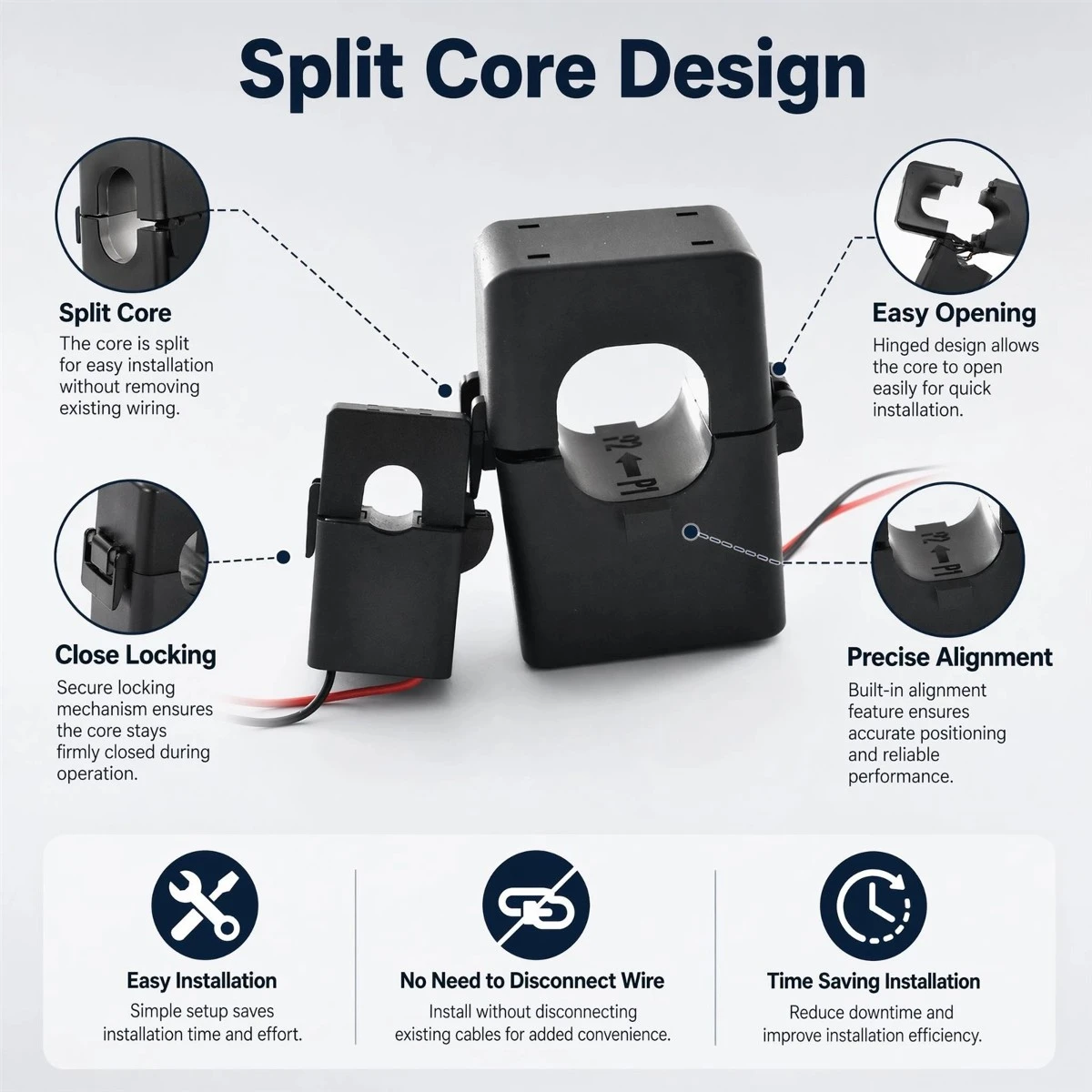
A split core current transformer is an electrical measuring device designed to measure alternating current (AC) flowing through a conductor. Unlike a traditional solid core current transformer, which requires the conductor to pass through a closed magnetic core, a split core CT features an opening mechanism that allows the core to be separated and clamped around an existing cable or busbar.
When AC current flows through the primary conductor, it generates a magnetic field. The CT detects this magnetic field and produces a proportional secondary signal that can be measured by an energy meter, power analyzer, or monitoring device.
The main advantage of this design is its installation convenience. Electricians can install a split core current transformer without removing the existing conductor, making it an effective choice for solar PV system upgrades and energy monitoring projects.
Typical applications include:
- Solar inverter output monitoring
- Grid import and export measurement
- Solar energy management systems
- Battery storage system monitoring
- Commercial and industrial PV installations
- Residential solar energy monitoring
2. Applications of Split Core CTs in Solar PV Systems
Split core current transformers play an important role in measuring electrical current at different points within a solar PV system.
2.1 Solar Inverter Output Monitoring
One of the most common applications is monitoring the AC output of a solar inverter.
After solar panels convert sunlight into DC electricity, the inverter converts the DC power into AC electricity for use by electrical loads or export to the utility grid.
Installing a split core CT around the inverter's AC output conductor allows the monitoring system to measure the current generated by the solar installation.
This information can help operators:
- Monitor real-time solar power generation
- Track inverter output performance
- Identify abnormal current variations
- Analyze daily and seasonal generation patterns
For three-phase solar inverters, a suitable CT is generally installed on each phase conductor, with the corresponding voltage and current inputs correctly matched.
2.2 Grid Import and Export Monitoring
Another important application is measuring the electricity exchanged between a solar PV system and the utility grid.
When solar generation exceeds building consumption, surplus electricity may be exported to the grid. When solar generation is insufficient, electricity is imported from the utility.
Split core current transformers can be installed at the point of common coupling (PCC) to monitor these current flows.
When connected to a compatible bidirectional energy meter, the monitoring system can help users:
- Measure electricity imported from the grid
- Monitor excess solar electricity exported to the grid
- Analyze self-consumption rates
- Support energy management and export limitation systems
Correct CT positioning, polarity, and phase assignment are essential for reliable import and export measurements.
2.3 Battery Energy Storage System Monitoring
Solar PV installations increasingly integrate battery energy storage systems (BESS) to store surplus electricity and improve energy utilization.
Split core current transformers can monitor AC current flowing between the inverter, battery system, electrical loads, and grid connection, depending on the system architecture.
This measurement data supports energy management functions such as:
- Monitoring charging and discharging behavior
- Tracking power flows
- Managing energy consumption
- Evaluating system operating performance
For DC-side battery current measurement, a standard AC current transformer is not suitable. A compatible DC current sensor or transducer must be selected instead.
2.4 Commercial and Industrial Solar Energy Monitoring
Commercial buildings, factories, warehouses, and industrial facilities often have complex distribution systems with multiple electrical feeders.
Split core current transformers offer a convenient solution for adding current monitoring to existing electrical panels without requiring extensive cable modifications.
They can be used to monitor individual circuits, distribution feeders, and solar inverter outputs.
Combined with an energy management system (EMS), the collected data helps facility managers understand electricity consumption, evaluate solar energy utilization, and identify opportunities for energy savings.
3. Why Choose Split Core Current Transformers for Solar PV Systems?
Compared with conventional solid core current transformers, split core CTs offer several practical advantages.
Easy Installation
The split core structure allows the transformer to open and close around an existing conductor. This simplifies installation in existing electrical panels and reduces the need for cable disconnection.
Ideal for Retrofit Projects
For solar PV systems that are already operating, adding current monitoring equipment can be challenging.
A split core current transformer provides a convenient retrofit option because the existing conductor does not need to be removed and threaded through a closed core.
Flexible Installation Options
Split core CTs are available in different aperture sizes, current ratings, and output configurations, making it easier to accommodate different cable sizes and monitoring requirements.
Suitable for Energy Monitoring
When properly selected and matched with compatible meters, split core current transformers can provide current measurement signals for solar monitoring, power monitoring, and energy management applications.
It is worth noting that split core designs may have different accuracy characteristics from solid core CTs. Proper core closure, installation, and product selection are important for achieving reliable measurements.
4. How to Choose the Right Split Core Current Transformer for Solar PV Systems
Selecting the correct split core CT is essential for obtaining accurate measurements and ensuring compatibility with the solar monitoring equipment.
Here are six important factors to consider.
4.1 Rated Primary Current
The CT's rated primary current should be selected according to the expected operating current of the monitored circuit.
For example, a 200A-rated split core CT is designed for applications with a corresponding primary current rating. However, the actual measurement range and accuracy must also be checked against the manufacturer's specifications.
Avoid selecting a CT based only on the circuit breaker's rating. Consider the actual operating current, maximum expected current, and required measurement range.
4.2 Aperture Size
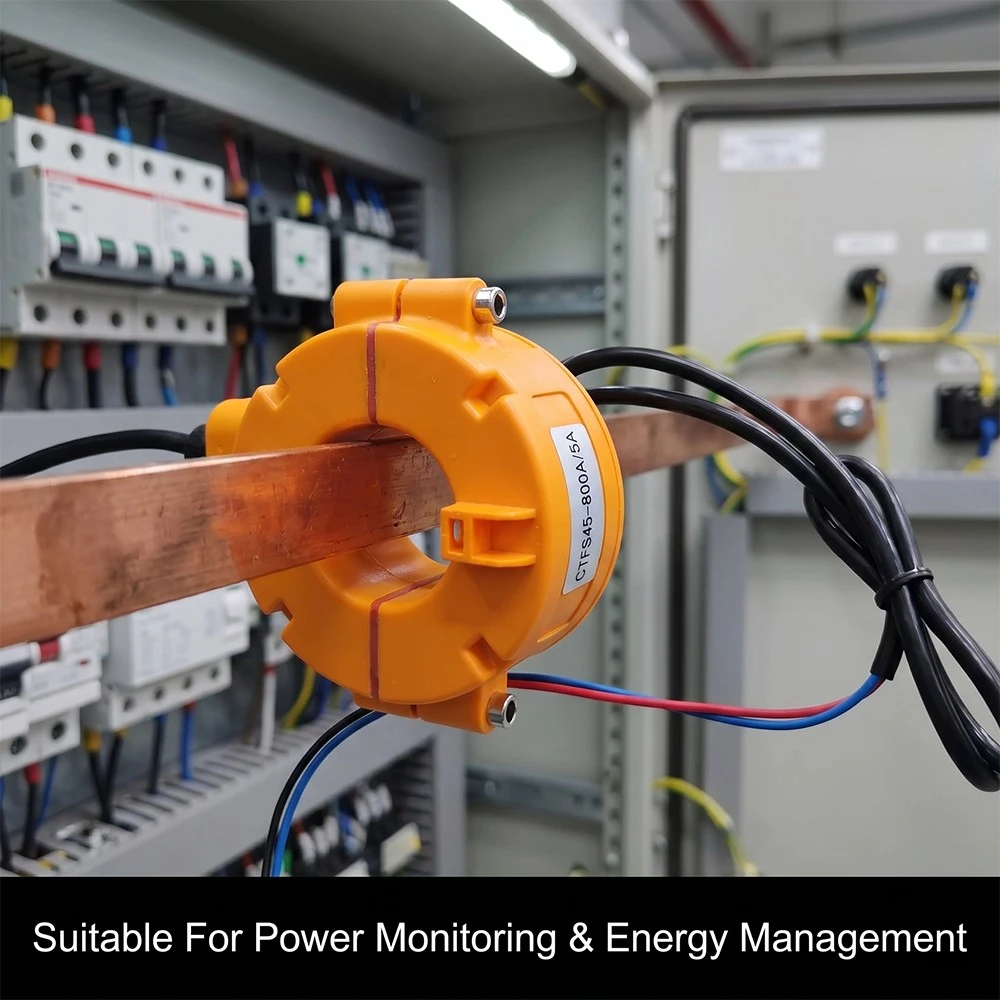
The aperture is the internal opening of the split core current transformer.
Before purchasing a CT, measure the outside diameter of the cable or the dimensions of the busbar that will pass through the opening.
The aperture must be large enough to accommodate the conductor while allowing the core to close completely.
An incorrectly sized CT may result in installation difficulties or improper core contact.
4.3 Accuracy Class
Accuracy is particularly important when measuring solar energy production, grid import, and export.
Different applications require different accuracy levels. General equipment monitoring may have less demanding requirements than energy accounting or billing-related measurements.
Choose an accuracy class that meets the requirements of the connected meter and the intended application.
Also consider the accuracy performance across the expected operating current range rather than relying solely on the rated-current accuracy specification.
4.4 Secondary Output
The CT output must match the input requirements of the connected energy meter or monitoring device.
Common configurations include:
- 5A secondary current output
- 1A secondary current output
- mA-level current output
- Voltage output, such as 333mV, where supported
These outputs are not interchangeable. Always confirm compatibility before ordering.
4.5 Installation Environment
Solar PV monitoring equipment may be installed in indoor distribution cabinets, outdoor electrical enclosures, or industrial environments.
Consider the following conditions:
- Operating temperature
- Humidity and moisture exposure
- Dust and contamination
- Mechanical vibration
- Insulation and voltage ratings
- Enclosure protection requirements
For outdoor installations, select a CT specifically rated for the environmental conditions. Not all split core current transformers are suitable for direct outdoor exposure.
4.6 Meter Compatibility and Electrical Specifications
Before finalizing your selection, verify that the CT is compatible with the inverter monitoring system, energy meter, or power analyzer.
Check the CT ratio, output type, accuracy, rated burden where applicable, frequency, and connection requirements.
A technically suitable CT may still produce incorrect readings if its electrical specifications do not match the connected monitoring equipment.
5. Installation Considerations for Solar PV Split Core CTs
Correct installation is essential for reliable solar energy measurements.
Follow these general considerations:
1. Select the correct installation location.
Determine whether the CT will monitor solar inverter output, grid import/export, or individual electrical loads.
2. Install around the correct conductor.
For single-phase circuits, place the CT around the intended current-carrying conductor. For three-phase systems, use the appropriate CT on each phase.
3. Check CT polarity.
Follow the manufacturer's directional markings, such as P1/P2, H1/H2, or an arrow. Incorrect polarity can result in reversed or negative power readings.
4. Ensure proper phase matching.
In three-phase systems, each CT current input must correspond to the correct voltage phase of the energy meter.
5. Confirm complete core closure.
Make sure the split core surfaces are clean, properly aligned, and fully closed to maintain measurement performance.
6. Follow electrical safety requirements.
Installation should be performed by qualified electrical personnel in accordance with the equipment manufacturer's instructions and applicable electrical regulations.
For conventional current-output CTs, never leave the secondary circuit open while primary current is flowing. Use appropriate short-circuiting and isolation procedures when required.
6. Why Work with a Professional Split Core Current Transformer Manufacturer?
For solar inverter manufacturers, energy monitoring system integrators, electrical contractors, and distributors, choosing a reliable split core current transformer manufacturer is an important part of project planning.
A professional manufacturer should be able to provide:
- Multiple primary current ratings
- Different aperture sizes and mechanical designs
- Various secondary output options
- Suitable accuracy classes
- Technical datasheets and installation instructions
- Custom product configurations for OEM projects
- Consistent product quality and technical support
For large-scale solar PV projects or specialized monitoring applications, customized split core current transformers can help meet specific installation and electrical requirements.
7. Conclusion
Split core current transformers provide a convenient and flexible solution for current measurement in solar PV systems. Their openable design makes them particularly useful for retrofit installations, inverter output monitoring, grid import and export measurement, and commercial energy management applications.
When selecting a split core current transformer for solar PV systems, it is important to consider rated primary current, aperture size, accuracy class, secondary output, environmental conditions, and meter compatibility.
By choosing the right CT and ensuring correct installation, solar system operators can obtain more reliable electrical measurement data and improve their energy monitoring capabilities.
Looking for a reliable split core current transformer for your solar PV project? Contact our technical team to discuss your required current rating, aperture size, output signal, accuracy class, and customization needs. We can help you identify a suitable solution for your solar energy monitoring application.
For more information, please contact us at sales@xfullstar.com