

What specifications matter when selecting a Lan transformer?
Oct 16, 2026
Leave a message
Choosing the right LAN transformer is essential for reliable Ethernet communication. Whether you are designing a network switch, router, industrial Ethernet device, IP camera, or PoE system, the transformer must match the requirements of the Ethernet PHY and the overall application.
So, what specifications should you consider when selecting a LAN transformer?
1. Ethernet Speed and Standard
Start by identifying the Ethernet standard required by your application, such as:
- 10/100BASE-T
- 1000BASE-T (Gigabit Ethernet)
- 2.5GBASE-T
- 5GBASE-T
- 10GBASE-T
A LAN transformer designed for 10/100BASE-T should not automatically be used for Gigabit or higher-speed Ethernet. Always confirm compatibility with your PHY datasheet.
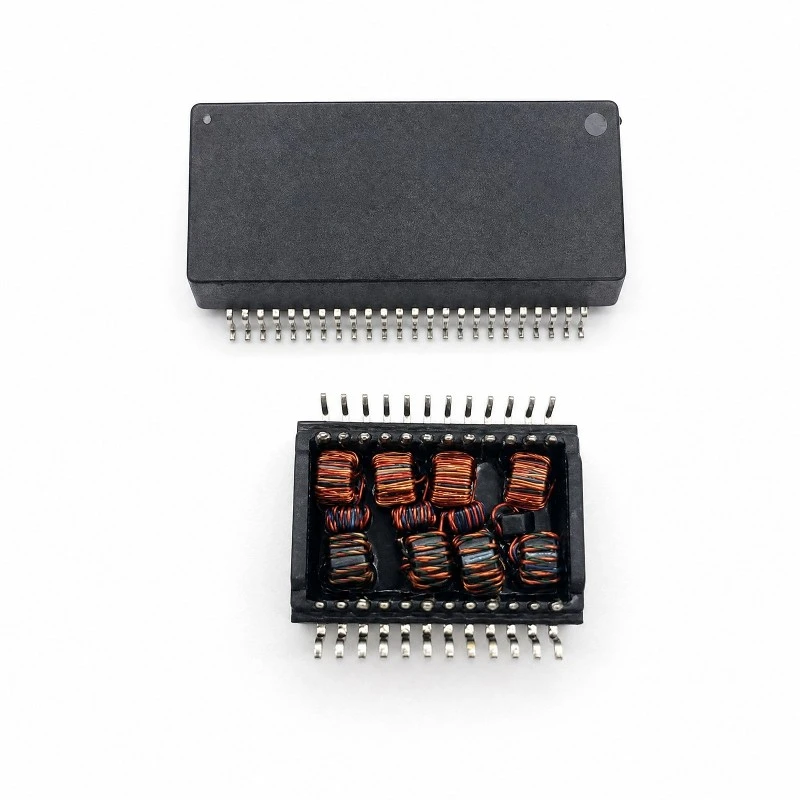
2. Turns Ratio
The turns ratio affects signal transmission and impedance matching between the PHY and Ethernet cable.
The correct ratio depends on the Ethernet PHY and its reference design. Using an unsuitable turns ratio may result in signal loss, impedance mismatch, or communication problems.
3. Open-Circuit Inductance (OCL)
Open-circuit inductance, or OCL, is an important specification for Ethernet magnetics. It affects low-frequency signal performance and must meet the requirements of the applicable Ethernet standard.
When comparing LAN transformers, check the minimum OCL value and test conditions, rather than looking only at the typical value.
4. Insertion Loss and Return Loss
Insertion loss indicates how much signal is lost as it passes through the transformer. Lower loss generally provides better signal transmission.
Return loss measures signal reflection caused by impedance mismatch. Good return-loss performance is particularly important for Gigabit and higher-speed Ethernet applications.
Both parameters should be evaluated across the relevant frequency range.
5. Isolation Voltage
Electrical isolation is one of the primary functions of an Ethernet transformer.
Check the transformer's:
- Isolation voltage
- Dielectric strength
- Insulation resistance
The required isolation level depends on the application and applicable safety requirements.
6. DCR and PoE Compatibility
DC resistance (DCR) represents the resistance of the transformer windings. Lower DCR can help reduce power losses and heat.
For PoE applications, also verify:
- DC current capability
- Thermal performance
- Isolation requirements
- Compatibility with the required PoE standard
A standard LAN transformer should not automatically be assumed to support PoE.
7. Common-Mode Choke Performance
Some LAN transformers integrate a common-mode choke (CMC) to help reduce common-mode noise and improve EMI/EMC performance.
If your application has strict EMC requirements, check the CMC characteristics and common-mode attenuation of the transformer.
8. Package, Footprint, and Pinout
Electrical compatibility is only part of the selection process. The transformer must also fit your PCB design.
Check:
- Package dimensions
- PCB footprint
- Pin configuration
- Component height
- SMD or through-hole construction
Always compare the transformer pinout with the PHY reference design before PCB layout.
9. Operating Temperature
For industrial and outdoor applications, operating temperature is especially important.
Make sure the LAN transformer can maintain its required electrical performance across the expected temperature range.
LAN Transformer Selection Checklist
| Specification | Key Consideration |
|---|---|
| Ethernet standard | 10/100, 1000BASE-T, 2.5G, 5G, etc. |
| Turns ratio | Match the PHY |
| OCL | Check minimum value and test conditions |
| Insertion loss | Minimize signal attenuation |
| Return loss | Ensure good impedance matching |
| Isolation | Meet system safety requirements |
| DCR | Consider power loss and heat |
| CMC | Evaluate EMI/EMC requirements |
| PoE | Verify current and PoE compatibility |
| Package | Match PCB space and footprint |
| Pinout | Match the PHY reference design |
| Temperature | Meet application requirements |
Final Thoughts
Selecting a LAN transformer requires more than simply matching the Ethernet speed. Engineers should consider turns ratio, OCL, insertion loss, return loss, isolation voltage, DCR, CMC performance, PoE compatibility, temperature rating, package, and pinout.
The best approach is to evaluate the LAN transformer together with the Ethernet PHY and the complete interface design. For OEM and high-volume projects, choosing an experienced LAN transformer manufacturer or Ethernet magnetics supplier can also help ensure performance, quality, customization, and long-term supply stability.
Need help selecting the right LAN transformer? Contact our technical team to discuss your Ethernet application and requirements.
For more information, please contact us at sales@xfullstar.com