

The Basics of Current Sensors
Aug 08, 2020
Leave a message
The Basics of Current Sensors
Current sensors are either open- or closed-loop. Open-loop current sensors measure AC and DC currents and provide electrical isolation between the circuit being measured and the output of the sensor (the primary current is measured without electrical contact with the primary circuit, providing galvanic isolation). Less expensive than their closed-loop cousins, open-loop current sensors are generally preferred in battery-powered circuits given their low-operating power requirements and small footprint features.
Closed-loop sensors measure AC and DC currents and provide electrical isolation. They offer fast response, high linearity, and low temperature drift. The current output of the closed-loop sensor is relatively immune to electrical noise. The Closed- Loop sensor is sometimes called a ‘Zero-Flux’ sensor because its Hall-Effect sensor feeds back an opposing current into a secondary coil, wound on the magnetic core to zero the flux produced in the magnetic core by the primary current. Closed-loop sensors are often the sensor of choice when high accuracy is essential.
Let’s now take a closer look at both types, starting with open-loop sensors.
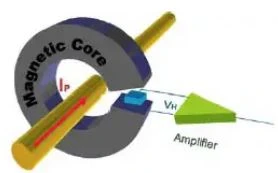
Open loop current sensors consist of a Hall sensor mounted in the air gap of a magnetic core (Fig. 1). A conductor produces a magnetic field comparable to the current. The magnetic field is concentrated by the core and measured by the Hall sensor. The signal from the Hall generator is low, so it is amplified, and it is this amplified signal that becomes the sensor’s output. Open-loop sensors normally have circuitry that provides temperature compensation and calibrated high-level voltage output. While they have a definite price advantage over closed-loop counterparts, their downside is that they can be prone to saturation and temperature drift. The drift can be minimized to some extent, however, by injecting a positive coefficient in the control current to reduce the drift in sensitivity over temperature.
For more information,please contact us at sales@xfullstar.com