

Audio Transformer
Apr 30, 2020
Leave a message
Audio Transformer
Audio Transformers are designed for use in audio amplifier applications for coupling and impedance matching of amplifiers and speakers
As well as stepping up (increase) or stepping down (decrease) a signal voltage, transformers also have one very other useful property, isolation. Since there is no direct electrical connection between their primary and secondary windings, transformers provide complete electrical isolation between their input and output circuits and this isolation property can also be used between amplifiers and speakers.
We have seen in this section about transformers, that a transformer is an electrical device which allows an sinusoidal input signal (such as an audio signal or voltage) to produce an output signal or voltage without the input side and output side being physically connected to each other. This coupling is achieved by having two (or more) wire coils (called windings) of insulated copper wire wound around a soft magnetic iron core.
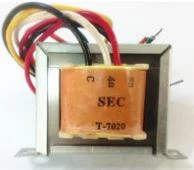
When an AC signal is applied to the primary input winding, a corresponding AC signal appears on the output secondary winding due to the inductive coupling of the soft iron core. The turns ratio between the input and output wire coils provides either an increase or a decrease of the applied signal as it passes through the transformer.
Then audio transformers can be considered as either a step-up or step-down type, but rather than being wound to produce a specific voltage output, audio transformers are mainly designed for impedance matching. Also, a transformer with a turns ratio of 1:1, does not change the voltage or current levels but instead isolates the primary circuit from the secondary side. This type of transformer is known commonly as an Isolation Transformer.
Transformers are not intelligent devices, but can be used as bidirectional devices so that the normal primary input winding can become an output winding and the normal secondary output winding can become an input and due to this bidirectional nature, transformers can provide a signal gain when used in one direction or a signal loss when used in reverse to help match signal or voltage levels between different devices.
Note also that a single transformer can have multiple primary or secondary windings and these windings may also have multiple electrical connections or “taps” along their length. The advantage of multi-tap audio transformers is that they offer different electrical impedances as well as different gain or loss ratios making them useful for impedance matching of amplifiers and speaker loads.
As their name suggests, audio transformers are designed to operate within the audio band of frequencies and as such can have applications in the input stage (microphones), output stage (loudspeakers), inter-stage coupling as well as impedance matching of amplifiers. In all cases, the frequency response, primary and secondary impedances and power capabilities all need to be considered.
Audio and impedance matching transformers are similar in design to low frequency voltage and power transformer, but they operate over a much wider frequency range of frequencies. For example, 20Hz to 20kHz voice range. Audio transformers can also conduct DC in one or more of their windings for use in digital audio applications as well as transforming voltage and current levels at high frequency.
For more information,please contact us at sales@xfullstar.com